|
( Wybrane Publikacje Grzegorza Michalskiego )
--
--
| Lp. | Title | Authors | Year | Source Title | Volume/Issue/Pages | Total Citations | DOI |
|---|---|---|---|---|---|---|---|
| 1 | INVENTORY MANAGEMENT OPTIMIZATION AS PART OF OPERATIONAL RISK MANAGEMENT | Michalski, Grzegorz | 2009 | ECONOMIC COMPUTATION AND ECONOMIC CYBERNETICS STUDIES AND RESEARCH | 43/4/213-222 | 43 | |
| 2 | VALUE MAXIMIZING CORPORATE CURRENT ASSETS AND CASH MANAGEMENT IN RELATION TO RISK SENSITIVITY: POLISH FIRMS CASE | Michalski, Grzegorz | 2014 | ECONOMIC COMPUTATION AND ECONOMIC CYBERNETICS STUDIES AND RESEARCH | 48/1/259-276 | 30 | |
| 3 | Full operating cycle influence on the food and beverages processing firms characteristics | Michalski, Grzegorz | 2016 | AGRICULTURAL ECONOMICS-ZEMEDELSKA EKONOMIKA | 62/2/71-77 | 29 | 10.17221/72/2015-AGRICECON |
| 4 | RISK PRESSURE AND INVENTORIES LEVELS. INFLUENCE OF RISK SENSITIVITY ON WORKING CAPITAL LEVELS | Michalski, Grzegorz | 2016 | ECONOMIC COMPUTATION AND ECONOMIC CYBERNETICS STUDIES AND RESEARCH | 50/1/189-196 | 27 | |
| 5 | Food processing firms inventory levels in hard times. 2004-2012 Slovak, Czech and Polish enterprises case | Raisova, Manuela; Buleca, Jan; Michalski, Grzegorz | 2014 | 17TH INTERNATIONAL CONFERENCE ENTERPRISE AND COMPETITIVE ENVIRONMENT 2014 | 12/-/557-564 | 27 | 10.1016/S2212-5671(14)00379-7 |
| 6 | Hospital Profitability vs. Selected Healthcare System Indicators | Bem, Agnieszka; Michalski, Grzegorz | 2015 | CENTRAL EUROPEAN CONFERENCE IN FINANCE AND ECONOMICS (CEFE2015) | -/52-61 | 26 | |
| 7 | Can We Determine Debt To Equity Levels In Non-Profit Organisations? Answer Based On Polish Case | Michalski, Grzegorz; Blendinger, Guenter; Rozsa, Zoltan; Cierniak-Emerych, Anna; Svidronova, Maria; Buleca, Jan; Bulsara, Hemantkumar | 2018 | INZINERINE EKONOMIKA-ENGINEERING ECONOMICS | 29/5/526-535 | 23 | 10.5755/j01.ee.29.5.19666 |
| 8 | Information and Communication Technologies in Healthcare: Still Innovation or Reality? Innovative and Entrepreneurial Value-creating Approach in Healthcare Management | Szczygiel, Nina; Rutkowska-Podolowska, Malgorzata; Michalski, Grzegorz | 2015 | CERS 2014: 5TH CENTRAL EUROPEAN CONFERENCE IN REGIONAL SCIENCE, INTERNATIONAL CONFERENCE PROCEEDINGS | -/1020-1029 | 21 | |
| 9 | PLANNING OPTIMAL FROM THE FIRM VALUE CREATION PERSPECTIVE. LEVELS OF OPERATING CASH INVESTMENTS | Michalski, Grzegorz | 2010 | ROMANIAN JOURNAL OF ECONOMIC FORECASTING | 13/1/198-214 | 20 | |
| 10 | TOWARDS TREASURY 4.0/THE EVOLVING ROLE OF CORPORATE TREASURY MANAGEMENT FOR 2020 | Polak, Petr; Masquelier, Francois; Michalski, Grzegorz | 2018 | MANAGEMENT-JOURNAL OF CONTEMPORARY MANAGEMENT ISSUES | 23/2/189-197 | 18 | 10.30924/mjcmi/2018.23.2.189 |
| 11 | LONG-TERM COMPETITIVENESS BASED ON VALUE ADDED MEASURES AS PART OF HIGHLY PROFESSIONALIZED CORPORATE GOVERNANCE MANAGEMENT OF GERMAN DAX 30 CORPORATIONS | Blendinger, Guenter; Michalski, Grzegorz | 2018 | JOURNAL OF COMPETITIVENESS | 10/2/5-20 | 18 | 10.7441/joc.2018.02.01 |
| 12 | EFFICIENCY OF ACCOUNTS RECEIVABLE MANAGEMENT IN POLISH INSTITUTIONS | Michalski, Grzegorz | 2012 | EUROPEAN FINANCIAL SYSTEMS 2012 | -/148-+ | 18 | |
| 13 | Operational risk in current assets investment decisions: Portfolio management approach in accounts receivable | Michalski, G. | 2008 | AGRICULTURAL ECONOMICS-ZEMEDELSKA EKONOMIKA | 54/1/12-19 | 18 | 10.17221/254-AGRICECON |
| 14 | Financial consequences linked with investments in current assets: Polish firms case | Michalski, Grzegorz | 2013 | EUROPEAN FINANCIAL SYSTEMS 2013: PROCEEDINGS OF THE 10TH INTERNATIONAL SCIENTIFIC CONFERENCE | -/213-+ | 16 | |
| 15 | Portfolio management approach in trade credit decision making | Michalski, Grzegorz | 2007 | ROMANIAN JOURNAL OF ECONOMIC FORECASTING | 8/3/42-53 | 16 | |
| 16 | Corporate inventory management with value maximization in view | Michalski, G. | 2008 | AGRICULTURAL ECONOMICS-ZEMEDELSKA EKONOMIKA | 54/5/187-192 | 15 | 10.17221/251-AGRICECON |
| 17 | The use of the internet by older adults in Poland | Dziuba, Szymon; Cierniak-Emerych, Anna; Michalski, Grzegorz; Poulova, Petra; Mohelska, Hana; Klimova, Blanka | 2021 | UNIVERSAL ACCESS IN THE INFORMATION SOCIETY | 20/1/171-178 | 12 | 10.1007/s10209-019-00700-y |
| 18 | FINANCIAL LIQUIDITY MANAGEMENT IN RELATION TO RISK SENSITIVITY: POLISH FIRMS CASE | Michalski, Grzegorz | 2012 | PROCEEDINGS OF THE INTERNATIONAL CONFERENCE QUANTITATIVE METHODS IN ECONOMICS (MULTIPLE CRITERIA DECISION MAKING XVI) | -/141-160 | 12 | |
| 19 | Value-based inventory management | Michalski, Grzegorz | 2008 | ROMANIAN JOURNAL OF ECONOMIC FORECASTING | 9/1/82-90 | 11 | |
| 20 | Remodeling of FLIEM: The Cash Management in Polish Small and Medium Firms with Full Operating Cycle in Various Business Environments | Michalski, Grzegorz; Rutkowska-Podolowska, Malgorzata; Sulich, Adam | 2018 | EFFICIENCY IN BUSINESS AND ECONOMICS | -/119-132 | 10 | 10.1007/978-3-319-68285-3_10 |
| 21 | Cash Levels and its Role in Full Operating Cycle Enterprises: 2005-2013 Czech, Slovak, Hungarian and Polish Enterprises Case | Michalski, Grzegorz; Brozyna, Emilia; Soroczynska, Joanna | 2015 | EUROPEAN FINANCIAL SYSTEMS 2015: PROCEEDINGS OF THE 12TH INTERNATIONAL SCIENTIFIC CONFERENCE | -/382-+ | 10 | |
| 22 | E-commerce as a Factor Supporting the Competitiveness of Small and Medium-Sized Manufacturing Enterprises | Brozyna, Emilia; Michalski, Grzegorz; Soroczynska, Joanna | 2015 | CENTRAL EUROPEAN CONFERENCE IN FINANCE AND ECONOMICS (CEFE2015) | -/80-90 | 9 | |
| 23 | Liquid Assets Strategies in Silesian Non-Profit Organizations | Michalski, Grzegorz; Mercik, Aleksander | 2011 | FINANCIAL MANAGEMENT OF FIRMS AND FINANCIAL INSTITUTIONS | -/258-270 | 9 | |
| 24 | Risk sensitivity indicator as correction factor for cost of capital rate | Michalski, Grzegorz | 2012 | MANAGING AND MODELLING OF FINANCIAL RISKS - 6TH INTERNATIONAL SCIENTIFIC CONFERENCE PROCEEDINGS, PTS 1 AND 2 | -/418-+ | 8 | |
| 25 | Crisis Influence on General Economic Condition and Corporate Liquidity Management. Financial Liquidity Investment Efficiency Model (FLIEM) use to Diagnose Polish Economics Standing | Michalski, Grzegorz | 2012 | PROCEEDINGS OF THE 7TH INTERNATIONAL CONFERENCE ON CURRENCY, BANKING AND INTERNATIONAL FINANCE - HOW DOES CENTRAL AND EASTERN EUROPE COPE UP WITH THE GLOBAL FINANCIAL CRISIS? | -/200-+ | 7 | |
| 26 | Agency Costs in Small and Medium Wood Industry Enterprises with Full Operating Cycle and Cash Levels | Michalski, Grzegorz | 2015 | INTERNATIONAL SCIENTIFIC CONFERENCE: BUSINESS ECONOMICS AND MANAGEMENT (BEM2015) | 34/-/461-468 | 6 | 10.1016/S2212-5671(15)01655-X |
| 27 | Relation Between Cash Levels and Debt in Small and Medium Wood and Furniture Industry Enterprises with Full Operating Cycle | Michalski, Grzegorz | 2015 | INTERNATIONAL SCIENTIFIC CONFERENCE: BUSINESS ECONOMICS AND MANAGEMENT (BEM2015) | 34/-/469-476 | 4 | 10.1016/S2212-5671(15)01656-1 |
| 28 | Decreasing operating risk in accounts receivable mangement: influence of the factoring on the firm value | Michalski, Grzegorz | 2008 | RIZENI A MODELOVANI FINANCNICH RIZIK | -/130-137 | 4 | |
| 29 | EFFECTIVE WORKING CAPITAL INVESTMENT - GERMAN FIRMS CASE | Michalski, Grzegorz | 2014 | PROCEEDINGS OF THE INTERNATIONAL CONFERENCE QUANTITATIVE METHODS IN ECONOMICS MULTIPLE CRITERIA DECISION MAKING XVII | -/176-181 | 3 | |
| 30 | A Value-oriented Framework for Inventory Management | Michalski, Grzegorz | 2009 | SOUTH EAST EUROPEAN JOURNAL OF ECONOMICS AND BUSINESS | 4/2/97-102 | 2 | 10.2478/v10033-009-0019-y |
| 31 | A Portfolio Management Approach in Accounts Receivable Management | Michalski, Grzegorz | 2008 | SOUTH EAST EUROPEAN JOURNAL OF ECONOMICS AND BUSINESS | 3/2/89-95 | 2 | 10.2478/v10033-008-0018-4 |
| 32 | Debt Capacity of Nonprofit Entities: Jobs on the Green Economy Background Case | Rutkowska, Malgorzata; Sulich, Adam; Michalski, Grzegorz | 2017 | CENTRAL EUROPEAN CONFERENCE IN FINANCE AND ECONOMICS (CEFE2017) | -/687-697 | 2 | |
| 33 | The Limitations of E-commerce Development in Full Operating Cycle Firms: V4 Countries Case | Brozyna, Emilia; Michalski, Grzegorz; Blendinger, Guenter; Ahmidat, Ahmed | 2016 | EUROPEAN FINANCIAL SYSTEM 2016: PROCEEDINGS OF THE 13TH INTERNATIONAL SCIENTIFIC CONFERENCE | -/57-+ | 2 | |
| 34 | Full operating cycle and its influence on enterprise characteristics: V4 food and beverages processing firms case | Michalski, Grzegorz | 2015 | 18TH INTERNATIONAL CONFERENCE ENTERPRISE AND COMPETITIVE ENVIRONMENT | -/559-568 | 2 | |
| 35 | WEATHER RISK REDUCTION AS KEY FOR FINANCIAL PERFORMANCE OF THE ENTERPRISE - SUSTAINABLE BUSINESS FRAMEWORK | Michalski, Grzegorz | 2015 | AKTUALNE PROBLEMY PODNIKOVEJ SFERY 2015 | -/416-427 | 2 | |
| 36 | Entrepreneurial Financial Liquidity Management Experiences and Perspectives in EU and Outside EU: German, Austrian and French Data Illustration | Michalski, Grzegorz | 2014 | PROCEEDINGS OF THE 2ND INTERNATIONAL CONFERENCE ON EUROPEAN INTEGRATION 2014 (ICEI 2014) | -/484-491 | 2 | |
| 37 | Accounts receivable levels in relation to risk sensitivity in manufacturing firms in V4 countries: 2003-2012 data testimony | Michalski, Grzegorz | 2013 | FINANCIAL MANAGEMENT OF FIRMS AND FINANCIAL INSTITUTIONS: 9TH INTERNATIONAL SCIENTIFIC CONFERENCE PROCEEDINGS, PTS I-III | -/538-+ | 2 | |
| 38 | Monte Carlo Simulations for Resolving Verifiability Paradoxes in Forecast Risk Management and Corporate Treasury Applications | Pavlik, Martin; Michalski, Grzegorz | 2025 | INTERNATIONAL JOURNAL OF FINANCIAL STUDIES | 13/2/49 | 0 | 10.3390/ijfs13020049 |
| 39 | The 5S Practice as A Condition for Employees' Creativity | Golej, Robert; Cierniak-Emerych, Anna; Michalski, Grzegorz | 2020 | EDUCATION EXCELLENCE AND INNOVATION MANAGEMENT: A 2025 VISION TO SUSTAIN ECONOMIC DEVELOPMENT DURING GLOBAL CHALLENGES | -/4687-4695 | 0 | |
| 40 | Sustainable Entity Framework as key for Increasing Financial Performance of the Weather Risk Sensitive Organizations | Michalski, Grzegorz; Golej, Robert | 2019 | VISION 2025: EDUCATION EXCELLENCE AND MANAGEMENT OF INNOVATIONS THROUGH SUSTAINABLE ECONOMIC COMPETITIVE ADVANTAGE | -/13620-13629 | 0 | |
| 41 | The Relationship between Debt and Equity in Social Economy Organizations - Polish Case | Michalski, Grzegorz | 2018 | EUROPEAN FINANCIAL SYSTEMS 2018: PROCEEDINGS OF THE 15TH INTERNATIONAL SCIENTIFIC CONFERENCE | -/410-419 | 0 | |
| 42 | LEVELS OF DEBT TO EQUITY RELATIONSHIP IN POLISH SOCIAL ECONOMY ORGANIZATIONS: EMPIRICAL SURVEY DATA | Grzegorz, Michalski | 2017 | FINANCE AND PERFORMANCE OF FIRMS IN SCIENCE, EDUCATION, AND PRACTICE | -/669-684 | 0 | |
| 43 | Financial Markets Turmoils and Firms Cash Levels in Real Economy | Michalski, Grzegorz | 2014 | ROLE OF FINANCIAL SECTOR IN SUPPORTING THE ECONOMIC RECOVERY OF CEE COUNTRIES, 8TH INTERNATIONAL CONFERENCE ON CURRENCY, BANKING AND INTERNATIONAL FINANCE | -/256-+ | 0 | |
| 44 | CRISIS CAUSED CHANGES IN INTRINSIC LIQUIDITY VALUE IN NON-PROFIT INSTITUTIONS | Michalski, Grzegorz | 2012 | EQUILIBRIUM-QUARTERLY JOURNAL OF ECONOMICS AND ECONOMIC POLICY | 7/2/139-158 | 0 | 10.12775/EQUIL.2012.015 |
| 45 | Polish and Silesian Non-Profit Organizations Liquidity Strategies | Michalski, Grzegorz; Mercik, Aleksander | 2011 | STATISTIKA-STATISTICS AND ECONOMY JOURNAL | 48/4/45-61 | 0 | |
| 46 | Risk reduction in SME financing: Jeremie fund influence on financial situation of small and middle enterprises | Michalski, Grzegorz | 2008 | RIZENI A MODELOVANI FINANCNICH RIZIK | -/138-147 | 0 |
| Authors | Title | Year | Source Title | Volume | Issue | Pages | Cited By | DOI |
|---|---|---|---|---|---|---|---|---|
| Michalski G. | A Portfolio Management Approach in Accounts Receivable Management | 2008 | South East European Journal of Economics and Business | 3 | 2 | 89-96 | 1 | 10.2478/v10033-008-0018-4 |
| Michalski G. | Nonprofit Organizations | 2018 | Global Encyclopedia of Public Administration, Public Policy, and Go.: With 294 Figures and 229 Tables | 4189-4193 | 0 | 10.1007/978-3-319-20928-9_10 | ||
| Michalski G. | Risk pressure and inventories levels. Influence of risk sensitivity on working capital levels | 2016 | Economic Computation and Economic Cybernetics Studies and Research | 50 | 1 | 189-196 | 24 | |
| Michalski G. | Value-based inventory management | 2008 | Romanian Journal of Economic Forecasting | 9 | 1 | 82-90 | 10 | |
| Michalski G. | Inventory Management | 2023 | Working Capital Management: Concepts and Strategies | 251-282 | 0 | 10.1142/9789811259661_0012 | ||
| Michalski G. | Planning optimal from the firm value creation perspective. levels of operating cash investments | 2010 | Romanian Journal of Economic Forecasting | 13 | 1 | 198-214 | 12 | |
| Pavlik M.; Michalski G. | Monte Carlo Simulations for Resolving Verifiability Paradoxes in Forecast Risk Management and Corporate Treasury Applications | 2025 | International Journal of Financial Studies | 13 | 2 | 1 | 10.3390/ijfs13020049 | |
| Michalski G. | Cash Management and Models | 2023 | Working Capital Management: Concepts and Strategies | 117-136 | 0 | 10.1142/9789811259661_0006 | ||
| Buleca J.; Andrejovská A.; Michalski G. | Macroeconomic factors' impact on the volume of household savings in the visegrad four countries | 2017 | Journal of Applied Economic Sciences | 12 | 5 | 1409-1421 | 1 | |
| Michalski G.; Rutkowska-Podołowska M.; Sulich A. | Remodeling of FLIEM: The Cash Management in Polish Small and Medium Firms with Full Operating Cycle in Various Business Environments | 2018 | Springer Proceedings in Business and Economics | 119-132 | 10 | 10.1007/978-3-319-68285-3_10 | ||
| Michalski G. | Value-based working capital management: Determining liquid asset levels in entrepreneurial environments | 2014 | Value-Based Working Capital Management: Determining Liquid Asset Levels in Entrepreneurial Environments | 1-181 | 11 | 10.1057/9781137391834 | ||
| Dziuba S.; Cierniak-Emerych A.; Michalski G.; Poulová P.; Mohelská H.; Klímová B. | The use of the internet by older adults in Poland | 2021 | Universal Access in the Information Society | 20 | 1 | 171-178 | 10 | 10.1007/s10209-019-00700-y |
| Michalski G. | A value-oriented framework for inventory management | 2009 | South East European Journal of Economics and Business | 4 | 2 | 97-102 | 3 | 10.2478/v10033-009-0019-y |
| Michalski G. | Corporate inventory management with value maximization in view | 2008 | Agricultural Economics | 54 | 5 | 187-192 | 13 | 10.17221/251-agricecon |
| Michalski G. | Nonprofit Organizations | 2023 | Global Encyclopedia of Public Administration, Public Policy, and Governance | 8662-8666 | 0 | 10.1007/978-3-030-66252-3_10 | ||
| Polak P.; Masquelier F.; Michalski G. | Towards treasury 4.0/the evolving role of corporate treasury management for 2020; [Prema riznici 4.0 – razvoj ulogu korporacijskog rizničkog menadžmenta za 2020. godinu] | 2018 | Management (Croatia) | 23 | 2 | 189-197 | 22 | 10.30924/mjcmi/2018.23.2.189 |
| Michalski G. | Inventory management optimization as part of operational risk management | 2009 | Economic Computation and Economic Cybernetics Studies and Research | 4 | 19 | |||
| Blendinger G.; Michalski G. | Long-term competitiveness based on value added measures as part of highly professionalized corporate governance management of German dax 30 corporations | 2018 | Journal of Competitiveness | 10 | 2 | 5-20 | 15 | 10.7441/joc.2018.02.01 |
| Michalski G. | Full operating cycle influence on the food and beverages processing firms characteristics | 2016 | Agricultural Economics (Czech Republic) | 62 | 2 | 71-77 | 14 | 10.17221/72/2015-AGRICECON |
| Michalski G. | Value maximizing corporate current assets and cash management in relation to risk sensitivity: Polish firms case | 2014 | Economic Computation and Economic Cybernetics Studies and Research | 48 | 1 | 15 | ||
| Michalski G. | Operational risk in current assets investment decisions: Portfolio management approach in accounts receivable | 2008 | Agricultural Economics | 54 | 1 | 12-19 | 12 | 10.17221/254-agricecon |
| Michalski G.; Blendinger G.; Rozsa Z.; Cierniak-Emerych A.; Svidronova M.; Buleca J.; Bulsara H. | Can we determine debt to equity levels in non-profit organisations? Answer based on Polish case | 2018 | Engineering Economics | 29 | 5 | 526-535 | 21 | 10.5755/j01.ee.29.5.19666 |
Obszary badawcze:
- Finanse przedsiębiorstwa
- Zarządzanie płynnością finansową:
- - krótkoterminowe decyzje finansowe i inwestycyjne;
- - zarządzanie należnościami, zapasami i innymi składnikami aktywów bieżących.
- Zarządzanie finansami małych firm:
- - decyzje finansowe małych przedsiębiorstw;
- - strategie finansowe małych podmiotów gospodarczych;
- - krótkoterminowe decyzje finansowe i inwestycyjne;
- Zarządzanie płynnością finansową:
Ważniejsze publikacje
Książki:
- Wartość płynności w bieżącym zarządzaniu finansami, Monografia naukowa oparta na pracy doktorskiej, CeDeWu, Warszawa 2004.
- Leksykon zarządzania finansami, C.H.Beck, Warszawa 2004.
- Podstawy zarządzania finansami, Monografia, WSZ Edukacja, Wrocław 2003.
- Finansowe strategie przedsiębiorstwa, Monografia, WSZiA Opole, Opole 2004.
- Budżetowanie kapitałów, (praca zbiorowa pod red. W. Pluty, współautorzy: W. Pluta, T. Jajuga, T. Słoński, R. Siedlecki i in.), PWE, Warszawa 2000.
- Finanse małych i średnich przedsiębiorstw, (praca zbiorowa pod red. W. Pluty, współautorzy: W. Pluta, T. Jajuga, T. Słoński, R. Siedlecki i in.), PWE, Warszawa 2004.
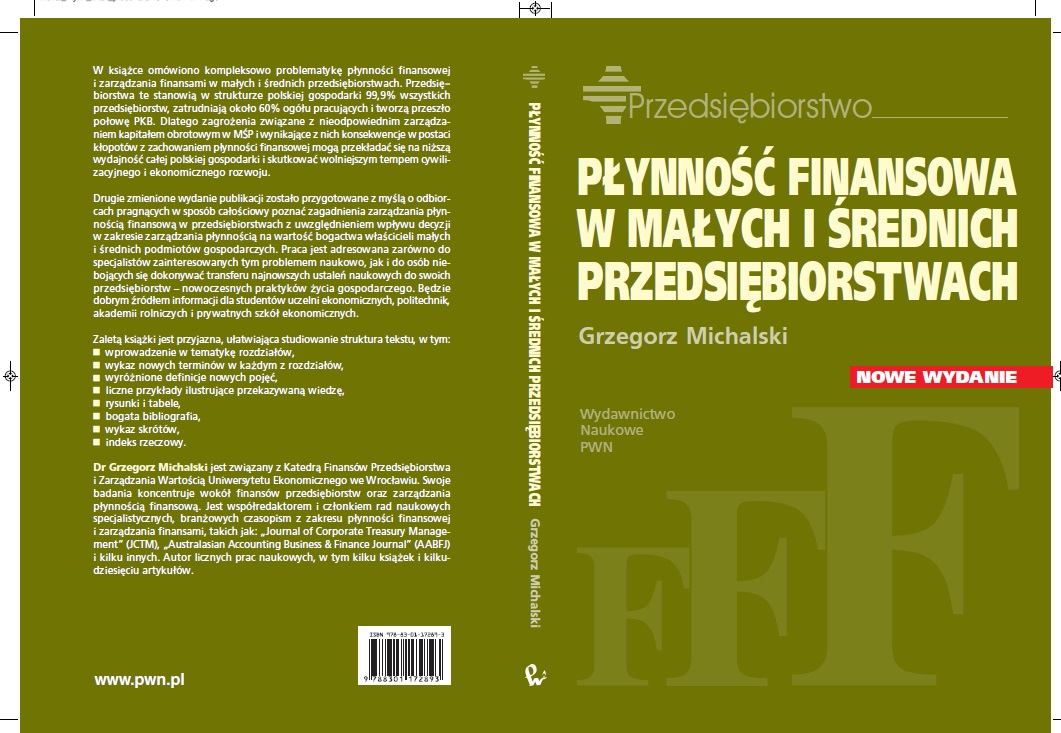
- Płynność finansowa małych i średnich przedsiębiorstw, WN PWE, Warszawa 2005.
- Krótkoterminowe zarządzanie kapitałem, (współautor: W. Pluta), C.H.Beck, Warszawa 2005.
- Tajniki finansowego sukcesu dla mikrofirm. Od uruchomienia do stabilnego wzrostu, (współautor: K. Prędkiewicz), C.H.Beck, Warszawa 2007.
- Ocena finansowa kontrahenta na podstawie sprawozdań finansowych, oddk, Gdańsk 2008.
Artykuły:
- VBEOQ optymalna z punktu widzenia maksymalizacji wartości przedsiębiorstwa wielkość zamówienia zapasów, [G. Michalski, autorstwo = 100%], w: E. Urbańczyk [red.], „Strategie wzrostu wartości przedsiębiorstwa”, Wydział Nauk Ekonomicznych i Zarządzania Uniwersytetu Szczecińskiego, Szczecin 2007, ISBN 978-83-60585-04-7, s. 523-531.
- Portfolio theory approach in the value based accounts receivable management, [G. Michalski, autorstwo = 100%], w: J. Krajicek [red.], "European financial systems 2007", Masaryk University, Faculty of Economics and Administration, Department of Finance, Brno 2007, ISBN 978-80-210-4319-0, s. 255-263.
- Wskaźniki poziomu płynności w małym przedsiębiorstwie, [G. Michalski, autorstwo = 100%], [w:] A. Bielawska [red.], „Uwarunkowania rynkowe rozwoju mikro i małych przedsiębiorstw”, Zeszyty Naukowe Uniwersytetu Szczecińskiego nr 458, Ekonomiczne problemy usług nr 10, Szczecin 2007, ISSN 1640-6818, s. 277-285.
- Elementy teorii portfela w zarządzaniu należnościami, [G. Michalski, autorstwo = 100%], [w:] B. Bernaś, W. Pluta [red.], „Zarządzanie finansami firm - teoria i praktyka”, Prace Naukowe Akademii Ekonomicznej we Wrocławiu nr 1159, Wrocław 2007, PL ISSN 0324-8445, s. 273-283.
- Risk-Based Cash Demand in a Firm, [G. Michalski, autorstwo = 100%], [w:] D. Dluhosová [red.], “Managing and modeling of financial risk”, Vysoká Skola Báňská - Technická Univerzita Ostrava, Ostrava 2006, ISBN 80-248-1159-6, s. 179-185.
- Powody utrzymywania gotówki w przedsiębiorstwie i ich relacja do ryzyka, [G. Michalski, autorstwo = 100%], w: W. Pluta [red.], „Zarządzanie finansami przedsiębiorstw - Teoria i Praktyka”, Prace Naukowe Akademii Ekonomicznej we Wrocławiu nr 1152, Wrocław 2007, PL ISSN 0324-8445, s. 365-375.
- Optymalna ze względu na wartość przedsiębiorstwa wielkość produkcji (VBPOQ), [G. Michalski, autorstwo = 100%], [w:] P. Karpuś, „Finanse przedsiębiorstwa”, UMCS Lublin 2006, ISBN 83-227-2558-2, s. 245 - 250.
- Zarządzanie finansami mikro- i małych przedsiębiorstw w warunkach ryzyka wynikającego z globalizacji, [G. Michalski, autorstwo = 100%], [w:] „Dylematy teorii i praktyki zarządzania”, M. Duczmal, T. Pokusa (red.), „Finansowo-społeczne problemy zarządzania w mikro- i makroskali”, Polska Akademia Nauk Oddział w Katowicach, Komisja Nauk Prawnych i Ekonomicznych, Wyższa Szkoła Zarządzania i Administracji w Opolu, Opole 2006, ISBN 83-88980-38-6, t.2, s. 46-64.
- Czynniki kształtujące koszt kapitału obcego w małym przedsiębiorstwie, [G. Michalski, autorstwo = 100%], w: „Uwarunkowania rynkowe rozwoju mikro i małych przedsiębiorstw”, A. Bielawska [red.], Zeszyty Naukowe Uniwersytetu Szczecińskiego, nr 427, „Ekonomiczne problemy usług”, Szczecin 2006, nr 2, ISBN 978-83-7241-543-1, s. 465-471.
- Wpływ czynników kształtujących poziom ostrożnościowych zasobów gotówki na wartość przedsiębiorstwa, [G. Michalski, autorstwo = 100%], w: „Strategie wzrostu wartości przedsiębiorstwa. Teoria i praktyka”, E. Urbańczyk [red.], ZN US nr 434, Prace Instytutu Ekonomiki i Organizacji Przedsiębiorstw nr 48, Wydział Nauk Ekonomicznych i Zarządzania, Wydawnictwo Uniwersytetu Szczecińskiego, Szczecin 2006, ISSN 1640-6818, t.1, s. 453-458.
- Zarządzanie zapasami w małym przedsiębiorstwie, [G. Michalski, autorstwo = 100%], Finanse, Bankowość, Rachunkowość nr 2, Prace Naukowe Akademii Ekonomicznej we Wrocławiu nr 1059, Wydawnictwo AE, Wrocław 2005, s. 190-197.
- Zarządzanie zapasami z uwzględnieniem ryzyka czasu dostaw i jego wpływ na wartość przedsiębiorstwa, [G. Michalski, autorstwo = 100%], [w:] J. Dziechciarz [red.], „Zastosowania metod ilościowych”, Prace Naukowe Akademii Ekonomicznej we Wrocławiu nr 1096, Ekonometria nr 15, Wydawnictwo AE, Wrocław 2005, PL ISSN 0324-8445, PL ISSN 1507-3866, s. 285 „ 296.
- Metody kontrolowania prawidłowości spływu należności, [G. Michalski, autorstwo = 100%], Finanse, Bankowość, Rachunkowość nr 3, Prace Naukowe Akademii Ekonomicznej we Wrocławiu nr 1062, Wydawnictwo AE, Wrocław 2005, s. 33-42.
- Strategie zarządzania kapitałem obrotowym a wzrost wartości MŚP, [G. Michalski, autorstwo = 100%], Studia i Prace Kolegium Zarządzania i Finansów, Zeszyt Naukowy 55, SGH, Warszawa 2005, s. 90-102.
- Optymalny poziom płynności finansowej w MŚP, [G. Michalski, autorstwo = 100%], w: „Rozprawy i studia”, pod red. A. Bielawska, US, Szczecin 2005, t. 571, s. 185-194.
- Krótkoterminowe źródła finansowania małych i średnich przedsiębiorstw, [G. Michalski, autorstwo = 100%], w: „Przekształcenia rynku finansowego w Polsce”, opracowanie monograficzne pod red. P. Karpuś, J. Węcławski, Wydawnictwo UMCS, Lublin 2005, t. 2, s. 171-184.
- Zastosowanie modeli zarządzania środkami pieniężnymi w przedsiębiorstwie, [G. Michalski, autorstwo = 100%], w: „Rynek Finansowy. Szanse i Zagrożenia Rozwoju”, T. 2: Zarządzanie finansami przedsiębiorstw i instytucji, opracowanie monograficzne pod red. P. Karpuś, J. Węcławski, Wydawnictwo UMCS, Lublin 2005, t. II, s. 39-53.
- Optymalna wielkość zamówienia zapasów a wartość przedsiębiorstwa, [G. Michalski, autorstwo = 100%], w: Zarządzanie Finansami. Finansowanie przedsiębiorstw w Unii Europejskiej, red. D. Zarzecki, US WNEiZ, Szczecin 2004, s. 291-300.
- Definicja i znaczenie krótkoterminowej płynności finansowej, [G. Michalski, autorstwo = 100%], Zarządzanie finansami firm - Teoria i praktyka, red. W. Pluta, PN 1042, AE, Wrocław 2004, 2 tom, s. 65-72.
- Relacja C/WK jako czynnik determinujący wewnętrzną wartość płynności, [G. Michalski, autorstwo = 100%], w: „Strategie i instrumenty alokacji kapitału finansowego”, opracowanie monograficzne pod red. P. Karpuś, J. Węcławski, Wydawnictwo UMCS, Lublin 2004, s. 409-419.
- Czynniki obniżające wewnętrzną wartość płynności, [G. Michalski, autorstwo = 100%], Finanse, Bankowość, Rachunkowość nr 1, Prace Naukowe Akademii Ekonomicznej we Wrocławiu nr 1012, Wydawnictwo AE, Wrocław 2004, s. 80-88.
- Metody pośrednio uwzględniające ryzyko operacyjne w zarządzaniu finansami małego przedsiębiorstwa, [G. Michalski, autorstwo = 100%], Ekonometria nr 14, Prace Naukowe Akademii Ekonomicznej we Wrocławiu nr 1021, Wydawnictwo AE, Wrocław 2004, s. 335-350.
- Powody utrzymywania płynności w przedsiębiorstwie produkcyjnym, [G. Michalski, autorstwo = 100%], w: „Zarządzanie Finansami. Mierzenie wyników i wycena przedsiębiorstw”, D. Zarzecki (red.), Uniwersytet Szczeciński, Wydział Nauk Ekonomicznych i Zarządzania, Szczecin 2003, ISBN 83-89142-11-2, t.II, s 91-99.
- Zarządzanie należnościami w małych i średnich przedsiębiorstwach z punktu widzenia wartości płynności finansowej, [G. Michalski, autorstwo = 100%], w: „Finansowe aspekty funkcjonowania małych i średnich przedsiębiorstw”, E. Orechwa-Maliszewska, A. Kopczyk (red.), Wydawnictwo Wyższej Szkoły Finansów i Zarządzania, Białystok 2003, ISBN 83-87256-56-0, s. 357-369.
- Optymalny poziom płynności finansowej „ propozycja wyznaczania, [G. Michalski, autorstwo = 100%], Finanse i Bankowość nr 10, Prace Naukowe Akademii Ekonomicznej we Wrocławiu nr 970, Wydawnictwo AE, Wrocław 2003, s. 30-39.
- Informacyjna przydatność statycznych miar poziomu płynności finansowej, [G. Michalski, autorstwo = 100%], Ekonometria nr 11, Prace Naukowe Akademii Ekonomicznej we Wrocławiu nr 981, Wydawnictwo AE, Wrocław 2003, s. 214-226.
- Korzy”ci firmy z utrzymywania płynności finansowej, [G. Michalski, autorstwo = 100%], Finanse i Bankowość nr 11, Prace Naukowe Akademii Ekonomicznej we Wrocławiu nr 972, Wydawnictwo AE, Wrocław 2003, s. 115-124.
- Bieżące zarządzanie finansami oparte na informacji o wartości płynności i jego wpływ na wartość przedsiębiorstwa, [G. Michalski, autorstwo = 100%], Zarządzanie nr 1, Prace Naukowe Akademii Ekonomicznej we Wrocławiu nr 998, Wydawnictwo AE, Wrocław 2003, s. 75-84.
- Dynamiczny pomiar płynności, [G. Michalski, autorstwo = 100%], Ekonometria nr 12, Prace Naukowe Akademii Ekonomicznej we Wrocławiu nr 1002, Wydawnictwo AE, Wrocław 2003, s. 185-199.
- Możliwości wpływania samorządu lokalnego na rozwój gospodarczy regionu, [G. Michalski, autorstwo = 100%], w: „Zarządzanie finansami w transformacji przedsiębiorstw”, red. T. Jajuga, T. Słoński, Prace Naukowe Akademii Ekonomicznej we Wrocławiu nr 837, Wydawnictwo AE Wrocław 1999, s. 248-253.
- Wybrane zagadnienia zarządzania kapitałem obrotowym w gminie, [G. Michalski, autorstwo = 100%], w: „Zarządzanie finansami, współczesne tendencje w teorii i praktyce”, WN US, Szczecin 2000, t. 1, s. 419-430.
- Finansowanie zewnętrzne a wartość płynności „ wybrane zagadnienia, [G. Michalski, autorstwo = 100%], w: „Finansowe wspomaganie rozwoju przedsiębiorstw”, red. P. Karpuś, J. Węcławski, Wydawnictwo UMCS, Lublin 2000, s. 315-326.
- W poszukiwaniu wartości płynności przedsiębiorstwa „ wybrane zagadnienia, [G. Michalski, autorstwo = 100%], Finanse i Bankowość nr 8, Prace Naukowe Akademii Ekonomicznej we Wrocławiu nr 904, Wydawnictwo AE, Wrocław 2001, s. 106-118.
- Model opcyjnej wartości płynności „ wybrane zagadnienia, [G. Michalski, autorstwo = 100%], Ekonometria nr 8, Prace Naukowe Akademii Ekonomicznej we Wrocławiu nr 915, Wydawnictwo AE, Wrocław 2001, s. 197-213.
- Pomiar poziomu płynności finansowej w przedsiębiorstwie - wybrane zagadnienia, [G. Michalski, autorstwo = 100%], w: Zarządzanie finansami firm - teoria i praktyka, red. W. Pluta, Prace Naukowe Akademii Ekonomicznej we Wrocławiu nr 894, Wydawnictwo AE, Wrocław 2001, 119-134.
- Opcyjna wartość płynności finansowej przedsiębiorstwa - zarys problemu, [G. Michalski, autorstwo = 100%], w: Inwestycje finansowe i ubezpieczenia „ tendencje światowe a polski rynek, red. K. Jajuga, W. Ronka - Chmielowiec, Prace Naukowe Akademii Ekonomicznej we Wrocławiu nr 890, Wydawnictwo AE, Wrocław 2001, t. 2, s. 239-250.
- Czynniki determinujące wewnętrzną wartość płynności, [G. Michalski, autorstwo = 100%], w: Rozwój rynku finansowego w Polsce, red. P. Karpuś, J. Węcławski, Wydawnictwo UMCS, Lublin 2001, s. 307-314.
- Kapitał obrotowy netto jako czynnik determinujący wewnętrzną wartość płynności finansowej, [G. Michalski, autorstwo = 100%], Finanse i Bankowość nr 9, Prace Naukowe Akademii Ekonomicznej we Wrocławiu nr 906, Wydawnictwo AE, Wrocław 2002, s. 67-84.
- Wpływ opóźnień w spłacie należności na budowę modelu wewnętrznej wartości płynności, [G. Michalski, autorstwo = 100%], Ekonometria nr 9, Prace Naukowe Akademii Ekonomicznej we Wrocławiu nr 935, Wydawnictwo AE, Wrocław 2002, s. 164-174.
- Wartość płynności w zarządzaniu należnościami, [G. Michalski, autorstwo = 100%], Zarządzanie i Marketing nr 22, Prace Naukowe Akademii Ekonomicznej we Wrocławiu nr 957, Wydawnictwo AE, Wrocław 2002, s. 144-159.
- Zarządzanie środkami pieniężnymi w oparciu o informację o wartości płynności, [G. Michalski, autorstwo = 100%], w: „Zarządzanie finansami, klasyczne zasady - nowoczesne narzędzia”, red. D. Zarzecki, US, WNEiZ, Szczecin 2002, t. 1, ss. 387-398.
- Możliwości finansowe i inwestycyjne związane z istnieniem rynku pieniężnego, [G. Michalski, autorstwo = 100%], w: Zarządzanie finansami firm - teoria i praktyka, red. W. Pluta, Prace Naukowe Akademii Ekonomicznej we Wrocławiu nr 965, Wydawnictwo AE, Wrocław 2002, s. 136-151.
- Zastosowanie teorii użyteczności do wyznaczania optymalnego poziomu płynności finansowej w przedsiębiorstwie, [G. Michalski, autorstwo = 100%], Ekonometria nr 10, Prace Naukowe Akademii Ekonomicznej we Wrocławiu nr 950, Wydawnictwo AE, Wrocław 2002, s. 182-196.